Table of Contents
- Understanding Workers’ Compensation vs. Personal Injury in Oklahoma
- Key Differences Between Workers’ Compensation and Personal Injury Claims
- Third-Party Liability Claims in Oklahoma Workplace Accidents
- Workers’ Comp or Personal Injury: Making the Right Choice
- Exceptions to the Exclusive Remedy Rule in Oklahoma
- Frequently Asked Questions About Oklahoma Workplace Injury Claims
- Secure the Compensation You Deserve with Stipe Law Firm
Understanding Workers’ Compensation vs. Personal Injury in Oklahoma
When you suffer a workplace injury in Oklahoma, understanding the difference between workers’ compensation and personal injury claims is essential to protecting your rights. The Oklahoma workers’ compensation versus personal injury distinction centers on a fundamental legal principle that determines which path to recovery is available to you.
The exclusive remedy rule under Oklahoma law generally prevents employees from suing their employer for workplace injuries. Under the Oklahoma exclusive remedy rule, workers’ compensation serves as your sole remedy against your employer, providing benefits regardless of who caused the accident. This no-fault system covers medical expenses, a portion of lost wages, and disability benefits, but it does not compensate for pain and suffering. In contrast, a personal injury lawsuit requires proving someone else’s negligence or fault but allows you to pursue damages for pain and suffering and other non-economic losses.
However, the exclusive remedy rule does not bar claims against negligent third parties. You may pursue third-party liability claims in your Oklahoma workplace accident if someone other than your employer or a coworker caused your injuries—such as a defective product manufacturer, a negligent driver at a worksite, or a subcontractor on a construction project. At Stipe Law Firm, we evaluate your case to determine whether third-party claims exist alongside your workers’ compensation benefits, helping you understand every option available.
Filing deadlines also differ between these two claim types. Workers’ compensation claims have shorter notice and filing requirements, while personal injury lawsuits in Oklahoma generally carry a two-year statute of limitations. The amount of a workers compensation settlement depends on the severity of your injury, your wage loss, and the permanency of your condition. We handle both types of claims and can guide you toward the path that maximizes your recovery. Stipe Law Firm is By Your Side.
Key Differences Between Workers’ Compensation and Personal Injury Claims
After a workplace injury, understanding the distinction between an oklahoma workers’ compensation versus personal injury claim is essential for protecting your rights. While both legal paths can provide financial recovery, they operate under fundamentally different rules. At Stipe Law Firm, we help injured workers across Southeast Oklahoma navigate these differences to pursue the full compensation they deserve.
The following table outlines the core distinctions between these two types of claims under Oklahoma law.
| Aspect | Workers’ Compensation | Personal Injury Lawsuit |
|---|---|---|
| Fault Requirement | No need to prove employer negligence | Must prove negligence or fault |
| Damages Available | No pain and suffering damages | Pain and suffering, emotional distress, full compensation |
| Statute of Limitations | Claim must be filed with the Workers’ Compensation Commission | 2 years from date of injury in Oklahoma |
The first major distinction is the fault requirement. Oklahoma’s workers’ compensation system is a no-fault system, meaning you do not need to prove your employer was negligent to receive benefits. As long as your injury arose out of and in the course of your employment, you are generally entitled to workers compensation benefits in Oklahoma. A personal injury lawsuit, by contrast, requires you to demonstrate that another party’s negligence caused your harm.
The types of damages available also differ significantly. Through workers’ compensation, you can recover medical expenses, a portion of lost wages, and disability benefits for permanent impairments, but you cannot receive compensation for pain and suffering or emotional distress. A successful personal injury claim, however, allows you to pursue the full spectrum of damages, including non-economic losses like pain and suffering.
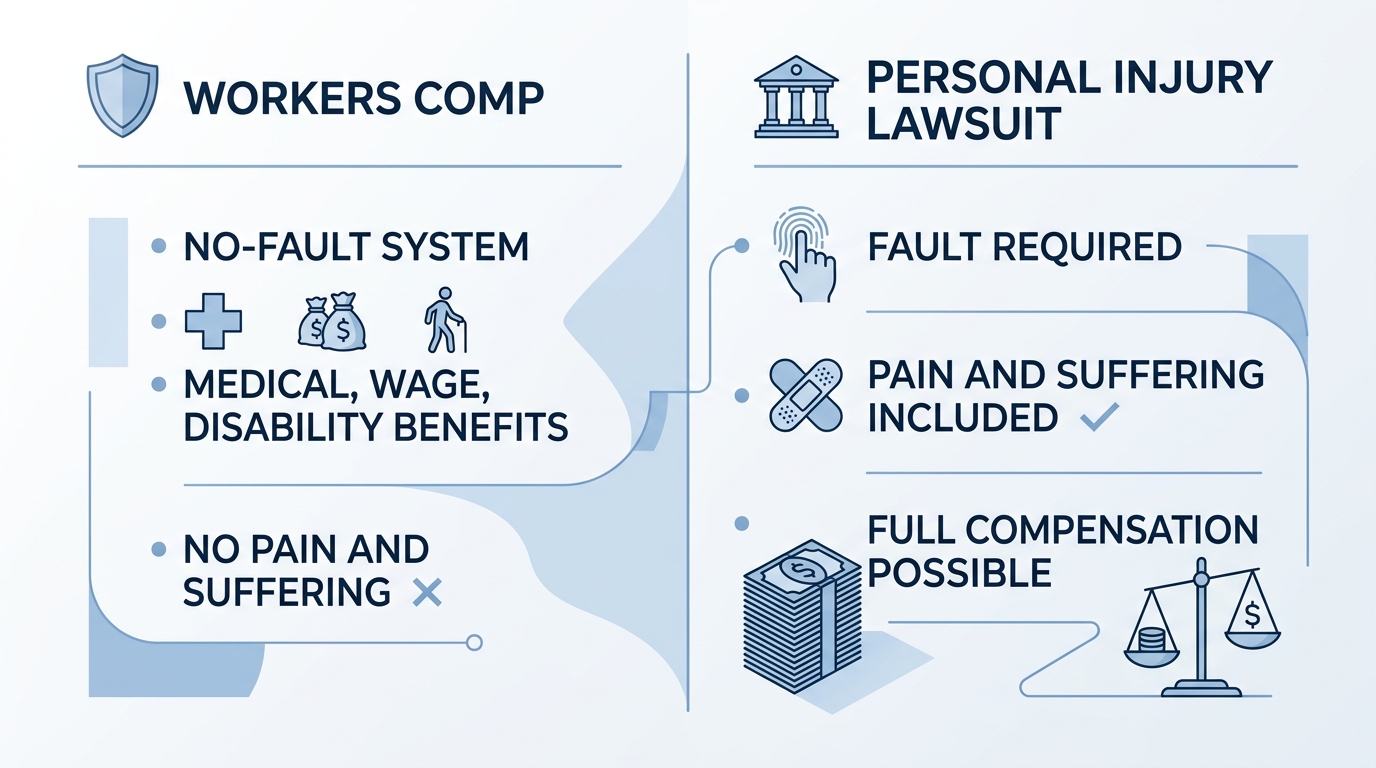
Comparison of workers’ compensation and personal injury claims at Stipe Law Firm.
The statute of limitations in Oklahoma also varies between these claim types. For workers’ compensation, you must notify your employer within 30 days of a single-event injury and generally file a formal claim within two years, though certain circumstances can shorten this window. Personal injury lawsuits carry a two-year statute of limitations from the date of the injury. Missing these deadlines can bar your recovery entirely, so prompt action is critical.
A cornerstone of Oklahoma workplace injury law is the exclusive remedy rule Oklahoma workplace injury doctrine. This rule generally prevents you from suing your employer for a work-related injury if workers’ compensation coverage is available. However, important exceptions exist. When a third party such as a contractor, equipment manufacturer, or another driver causes your injury, you may pursue third-party liability claims Oklahoma workplace alongside your workers’ compensation claim. This dual-path approach allows you to seek full tort damages from the negligent third party while still receiving statutory workers’ compensation benefits.
We understand that these legal distinctions can feel overwhelming when you are focused on healing. Our team brings Experience You Can Trust to every case, helping you evaluate all potential avenues of recovery. Because each situation is unique, we encourage you to contact us for a Free Case Evaluation to discuss which path best serves your needs.
Third-Party Liability Claims in Oklahoma Workplace Accidents
When a workplace injury occurs, many injured workers wonder about the difference between oklahoma workers’ compensation versus personal injury claims. While workers’ compensation provides a safety net for medical bills and a portion of your lost wages, it is not always the only financial remedy. We at Stipe Law Firm understand that other parties beyond your employer may share responsibility for your accident. In these situations, a third-party liability lawsuit can open the door to significantly greater compensation than what is available through the workers’ comp system alone.
The core legal principle governing these situations is the exclusive remedy rule. Under the exclusive remedy rule Oklahoma workplace injury law establishes, you generally cannot sue your employer for a work-related injury outside of the workers’ compensation framework. Your employer provides comp benefits regardless of fault, and in exchange, they are immune from a personal injury lawsuit. However, this immunity does not extend to other negligent parties. If a person or company other than your employer caused or contributed to your accident, you are free to pursue a claim directly against them, making this a critical exception to the rule.
Who Can Be Sued as a Third Party in Oklahoma?
Identifying all liable parties is a central task in any serious injury case. Because third-party liability claims Oklahoma workplace accidents generate are separate from workers’ comp, they can be brought against any at-fault entity except your direct employer. On a construction site, a general contractor or subcontractor whose negligence created a hazard could be a third-party defendant. If a piece of heavy machinery, a safety harness, or a power tool malfunctioned due to a design or manufacturing flaw, the equipment’s manufacturer is a potential target. In vehicle-related accidents—such as a delivery driver hit by another motorist—the at-fault driver is a classic third-party defendant. Even a property owner who fails to maintain safe premises for a visiting worker can be held liable under Oklahoma premises liability law. Our firm carefully investigates each case to uncover every possible source of recovery.
Damages Recoverable in Third-Party Liability Claims
A major advantage of a third-party lawsuit is the breadth of damages you can pursue, which go well beyond the limited benefits of a workers’ comp claim. While workers’ compensation in Oklahoma covers medical care and a percentage of your lost wages, it does not compensate you for your personal suffering. In a personal injury claim against a third party, you can seek full recovery for all your losses. This includes not only past and future medical expenses but also the complete amount of your lost income, not just a fractional benefit. More importantly, you can demand compensation for non-economic damages like physical pain, emotional distress, disfigurement, and the loss of enjoyment of life. This crucial distinction often makes a third-party claim the primary source of meaningful financial justice for a devastating injury.
To help clarify these critical differences, the following table compares the two systems side-by-side.
| Factor | Workers’ Compensation | Third-Party Liability |
|---|---|---|
| Who Can Be Sued | Employer (but limited to comp benefits) | Any non-employer third party |
| Pain and Suffering | Not compensated | Available |
| Subrogation | N/A | Employer/carrier may have lien on recovery |
| Attorney Fees | Fees often limited | Contingency fee typical |
This comparison highlights a fundamental reality: a workers’ comp claim alone often leaves an injured worker shouldering immense personal costs without full accountability. The right to file a third-party action restores that accountability, allowing you to hold truly negligent parties responsible for the complete spectrum of harm they have caused. Understanding this landscape is the first step toward making an informed choice about your legal options.
How a Third-Party Settlement Affects Workers’ Comp Benefits
The intersection of these two legal systems is governed by the principle of subrogation. When you receive a settlement or judgment from a third party, the workers’ compensation insurance carrier that has been paying your medical bills and lost wages is legally entitled to be paid back. This is to prevent a “double recovery” where a worker would receive duplicate benefits for the same injury. The carrier will place a lien against your third-party recovery to recoup the funds they have already expended on your behalf. We work to negotiate these liens to maximize the amount that ultimately goes into your pocket, ensuring that pursuing a third-party claim is still financially beneficial for you even after accounting for the reimbursement.
It is also important to understand how future benefits under Oklahoma workers compensation benefits 2026 could be impacted. A sophisticated settlement in a third-party case will structure the award to account for the future obligation, often resulting in a compromise of the workers’ comp lien. This careful negotiation is one of the most valuable services we provide. If you have been hurt at work, the combination of a workers’ compensation claim and a third-party liability lawsuit can be complex. Stipe Law Firm is By Your Side through every stage of this process, and we offer a no-obligation Free Case Evaluation to help you understand your rights. Contact us today to ensure you are pursuing every dollar available for your recovery.
Workers’ Comp or Personal Injury: Making the Right Choice
Workplace injuries in Oklahoma can lead to complex legal decisions, especially when weighing Oklahoma workers’ compensation versus personal injury claims. The path you choose can significantly impact the compensation you receive for medical bills, lost wages, and pain and suffering. Understanding the key differences between these two legal remedies helps injured workers make informed choices during an already difficult time.
When an accident happens on the job, many workers assume they only have one option. In reality, the circumstances of your injury determine whether you file a workers’ comp claim, pursue a lawsuit, or both. Stipe Law Firm has seen how these distinctions shape case outcomes across Southeast Oklahoma, from McAlester to Poteau. The following comparison clarifies which approach may apply to your situation.
The table below outlines common workplace injury scenarios and how workers’ compensation and personal injury law treat each one.
| Scenario | Workers’ Comp | Personal Injury Lawsuit |
|---|---|---|
| Injury caused by coworker | Exclusive remedy, no suit against coworker | Generally not allowed against coworker |
| Injury caused by defective equipment | May file comp claim | May sue equipment manufacturer as third party |
| Employer has no workers’ comp insurance | Employer may face penalties | You may sue employer directly |
These scenarios demonstrate that workers’ compensation and personal injury lawsuits offer different paths depending on who caused the harm. Injury caused by defective equipment, for example, involves the exclusive remedy rule for your employer yet may open the door to a claim against the equipment manufacturer. Similarly, an employer who fails to carry required insurance faces penalties under Oklahoma law and may be subject to a direct lawsuit. We at Stipe Law Firm help clients evaluate which route aligns with their specific circumstances.
When Workers’ Compensation Is Your Sole Remedy
Under Oklahoma law, workers’ compensation serves as the exclusive remedy rule for most workplace injuries. This rule means you generally cannot sue your employer or a coworker for negligence when you are hurt on the job. Instead, the workers’ comp system provides benefits regardless of fault — a trade-off designed to ensure injured employees receive medical care and wage replacement without lengthy court battles.
The exclusive remedy rule in Oklahoma workplace injury cases applies broadly. Whether a coworker’s momentary lapse caused your accident or machinery malfunctioned during routine operations, your initial recourse is a workers’ comp claim. This no-fault system covers medical treatment, temporary disability payments, and permanent impairment benefits. According to Stipe Law Firm’s experience handling workplace injury claims, approximately 20% of initial workers’ compensation claims are denied, often due to procedural errors or insufficient medical evidence. Prompt reporting — within 30 days in writing — and thorough documentation strengthen your claim and preserve your right to benefits.
When You Can Pursue a Personal Injury Lawsuit
There are important exceptions to the exclusive remedy rule where personal injury lawsuits become available. Third-party liability claims in Oklahoma workplace accidents arise when someone other than your employer or coworker causes your injury. A defective piece of equipment, for example, may support a products liability claim against the manufacturer. Similarly, if a negligent driver from another company hits you at a job site, you may pursue damages beyond what workers’ comp provides.
Two other scenarios permit lawsuits against employers directly. When an employer intentionally harms a worker, the exclusive remedy rule does not shield them from liability. The Oklahoma State Government enforces employer obligations regarding workplace safety and insurance coverage — if your employer lacks workers’ comp insurance altogether, you may sue them directly rather than proceeding through the comp system. These situations involve complex legal questions, and our firm offers free case evaluations to help you understand which remedies apply.
Steps to Take After a Workplace Injury in Oklahoma
Taking the right actions immediately after a workplace injury protects both your health and your legal options. First, report the injury to your employer in writing and do so within 30 days — Oklahoma law sets this deadline for preserving your right to workers’ comp benefits. Second, seek medical attention promptly and follow all treatment recommendations. Immediate care establishes a clear link between your injury and the workplace, which becomes critical if your claim faces scrutiny.
Third, document everything. Keep records of medical visits, take photos of the accident scene if possible, and note the names of witnesses. Fourth, avoid giving recorded statements to insurance adjusters or signing any documents before speaking with an attorney. Our firm has seen how these early interactions can inadvertently weaken a valid claim. Finally, consult a lawyer who understands both Oklahoma workers’ compensation versus personal injury claims and can identify whether third-party liability claims in Oklahoma workplace accidents apply to your case.
Stipe Law Firm draws on over 60 years of combined experience to guide injured workers through this process. We offer free, no-obligation case evaluations so you can understand your options without pressure.
Exceptions to the Exclusive Remedy Rule in Oklahoma
While workers’ compensation is designed as the primary remedy for workplace injuries in Oklahoma, the law recognizes situations where this protection is not absolute. Understanding the distinction between Oklahoma workers’ compensation versus personal injury claims begins with knowing that the system’s foundational rule has critical exceptions. At Stipe Law Firm, we guide injured workers through these nuanced scenarios to identify every available path to full compensation.
The exclusive remedy rule generally shields employers from lawsuits by employees who suffer on-the-job injuries covered by workers’ compensation. However, this rule opens a significant door when an injury is caused by a third party who is not your employer or a co-worker. In these cases, you can pursue third-party liability claims Oklahoma workplace law allows, while still receiving workers’ compensation benefits. Common third-party scenarios include accidents caused by negligent drivers if you were working on the road, injuries from defective machinery built by outside manufacturers, or hazards created by property owners where your job duties took you.
We help clients understand that filing both a workers’ compensation claim and a personal injury lawsuit for the same accident is legally permissible. However, Oklahoma law includes robust subrogation rights, meaning the workers’ compensation insurance carrier may have a lien on any third-party recovery to recoup benefits paid. Navigating this process without legal guidance can jeopardize your benefits, which is why we emphasize careful coordination of both claims. Another critical exception to the exclusive remedy rule Oklahoma workplace injury doctrine involves intentional employer misconduct.
Frequently Asked Questions About Oklahoma Workplace Injury Claims
Understanding the difference between Oklahoma workers compensation versus personal injury can feel confusing after a workplace accident. The following information is general in nature and is not legal advice. Past results do not guarantee similar outcomes.
What is the difference between workers’ compensation and a personal injury claim for an Oklahoma workplace accident?
Workers’ compensation is a no-fault system that provides medical and wage-loss benefits regardless of who caused the accident. A personal injury claim, by contrast, requires proof of negligence and allows you to pursue pain and suffering damages. The distinction matters because choosing the right path affects the compensation available to you. In Oklahoma, the exclusive remedy rule generally prevents you from suing your employer directly.
Can I sue my employer if they were negligent?
In most situations, the exclusive remedy rule Oklahoma workplace injury law applies. This employer liability rule bars a lawsuit against your own employer for a workplace accident, even when negligence played a role. There are limited exceptions — for example, when the employer intentionally caused the harm or failed to carry required insurance — but these circumstances are rare.
How do third-party claims work for an Oklahoma workplace accident?
Third-party liability allows you to step outside the workers’ compensation system and pursue a personal injury claim against someone other than your employer. Third-party liability claims Oklahoma workplace incidents often involve equipment manufacturers, subcontractors, or property owners whose negligence contributed to your injuries.
Do I need a lawyer for a workplace injury claim?
Every workplace injury raises important choices about which type of claim to file and what deadlines apply. Oklahoma’s procedural requirements are strict, and missing a filing window can end your case before it begins. Stipe Law Firm is By Your Side with the guidance you need to make informed decisions. We offer no-obligation case evaluations for a Free Case Evaluation.
Secure the Compensation You Deserve with Stipe Law Firm
Understanding the difference between workers’ compensation versus personal injury in Oklahoma is just the first step. At Stipe Law Firm, our team helps you evaluate whether your case is limited to the exclusive remedy rule Oklahoma workplace injury provision or if third-party liability claims Oklahoma workplace rules open the door to additional recovery.
With over 60 years of combined experience and a record of multimillion-dollar verdicts and settlements, our attorneys are ready to stand by you. Stipe Law Firm is By Your Side — call or submit our contact form today to schedule your no-obligation consultation.
Resources
- How Workers Compensation Settlements Calculate in Oklahoma
- Get Oklahoma Workers Compensation Benefits Explained
- Complete Guide to Oklahoma 2026 Workers Compensation Benefits
- Workers Compensation Settlement Guide for Oklahoma Claimants
- Guide to Workplace Injury Claims in Southeast Oklahoma
- Find Oklahoma State Government Services and Resources